Chained SHA-256 hash
Each record has a hash over the issuer tax ID, number, date, invoice type, tax amount, total, previous hash and record timestamp. Each company has its own chain.
VeriFactu guide
VeriFactu is the Spanish Tax Agency (AEAT) system that requires every invoice to create a record with a chained hash and a QR code, sent to the AEAT by the invoicing software. It applies from 01/01/2027 to companies and 01/07/2027 to everyone else.
VeriFactu (VERI*FACTU in the regulation) is the reporting mode defined by Royal Decree 1007/2023, the Spanish regulation on invoicing software. It sets what any program used to issue invoices must do: keep a record of every invoice that cannot be altered without leaving a trace, chain it to the previous one and be able to prove it.
In practice the software changes, not the way you invoice. If the software complies, you keep creating invoices as before; the record, the hash, the QR code and the submission are handled by the program.
01/01/2027
Corporate income tax payers
01/07/2027
Everyone else (sole traders and others)
SHA-256
Hash per record, chained to the previous one
1
AEAT QR code on every invoice
It applies to businesses and professionals who issue invoices with software and are taxed under the common Spanish regime. Current dates were set by Royal Decree-law 15/2025 (Official State Gazette, 03/12/2025).
| Who | Date | Rule |
|---|---|---|
| Corporate income tax payers | 01/01/2027 | RDL 15/2025, BOE 03/12/2025 |
| Everyone else: sole traders, partnerships… | 01/07/2027 | RDL 15/2025, BOE 03/12/2025 |
| New postponement to October 2028 | Announced by the Treasury on 05/10/2026 | Not yet in the Official Gazette: dates unchanged for now |
The regulation allows two ways to comply. FacturAda works in VERI*FACTU mode: every record is sent to the AEAT when the invoice is issued.
| VERI*FACTU | Non-VERI*FACTU | |
|---|---|---|
| Submission to the AEAT | Automatic, record by record | Not sent; kept and delivered on request |
| Signature of each record | Not required | Electronic signature of each record |
| QR code on the invoice | Yes | Yes |
| Legend on the invoice | «Factura verificable en la sede electrónica de la AEAT» | No |
| Chained hash | Yes | Yes |
| FacturAda mode | Yes | No |
Everything VERI*FACTU requires is included in every installation. What follows is checked against the product code.
There is no certification of VeriFactu software. The software producer signs a responsible declaration (declaración responsable) stating that the system complies, one per version, as set out in RD 1007/2023, amended by RD 254/2025, and Order HAC/1177/2024.
FacturAda’s declaration, signed by SOFTNAT S.L., is included in every installation and available from the plan settings in the app. More in what the responsible declaration is.
Four steps, once per company.
In the company profile, upload the electronic certificate and enter its password. It must include the legal representative and the company details. FacturAda shows the issuer and the expiry date.
In the VeriFactu block of the same profile, switch it on. It cannot be activated without a valid certificate.
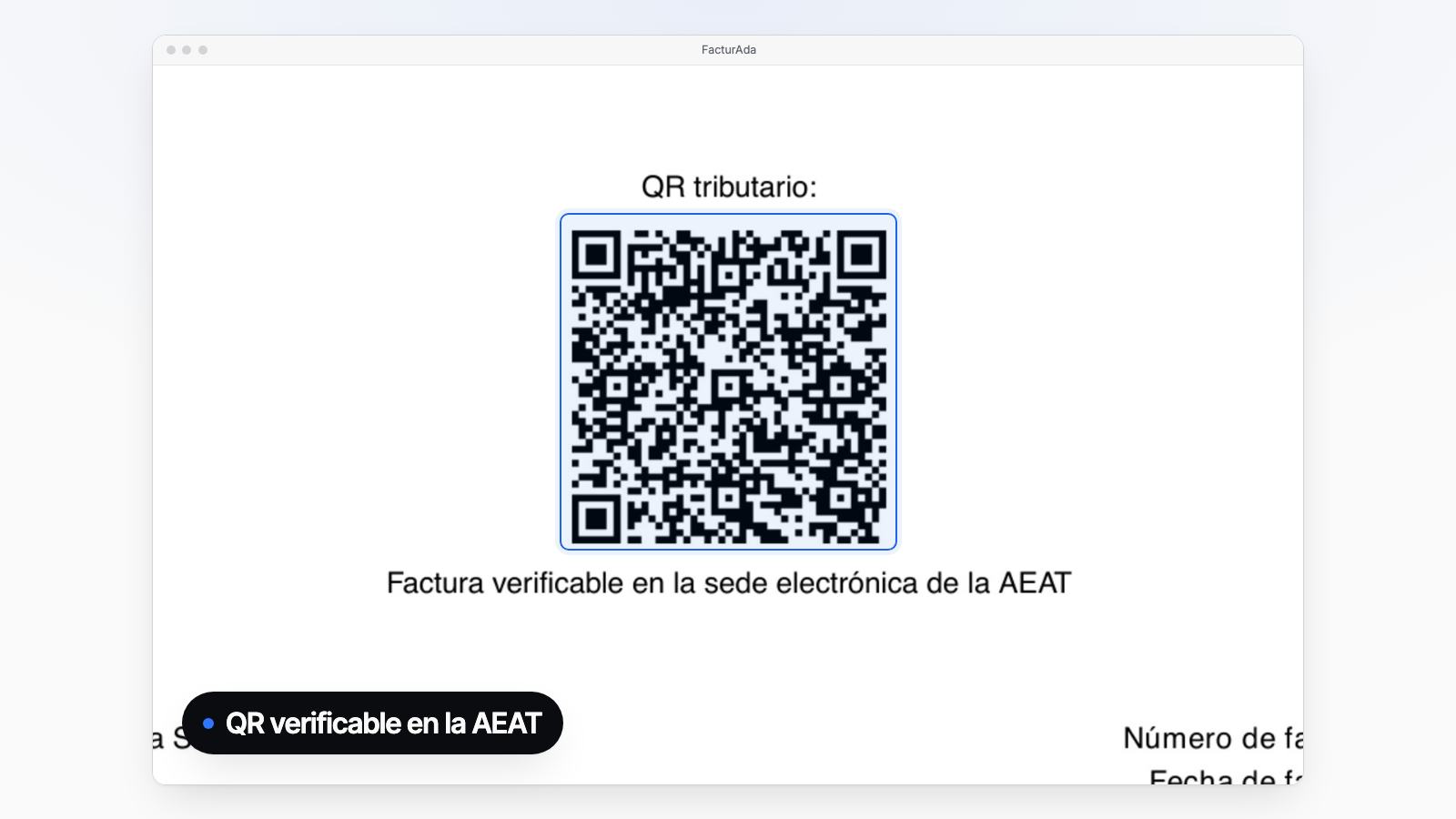
When it is created, the SHA-256 hash chained to the previous record is calculated and the AEAT QR code is generated and printed on the PDF.
The record is sent to the AEAT automatically. «VeriFactu records» shows the XML sent, the response and, if rejected, the reason.
What to have sorted before your date.
It is the mode of the Spanish invoicing software regulation (RD 1007/2023) in which the software sends a record of each invoice to the AEAT when it is issued, with a chained hash and a QR code on the invoice.
From 01/01/2027 for corporate income tax payers and from 01/07/2027 for everyone else, under Royal Decree-law 15/2025 (BOE 03/12/2025). On 05/10/2026 the Treasury announced a postponement to October 2028 that is not yet in the Official Gazette.
Yes, if they invoice with software and are not under SII. Their date is 01/07/2027.
No. The AEAT does not certify software. The producer signs a responsible declaration for each version stating that it complies.
No. VeriFactu covers recording and reporting your invoices to the AEAT. Mandatory B2B e-invoicing (Crea y Crece law, RD 238/2026) covers exchanging structured invoices between businesses, with other dates: 06/10/2027 and 06/10/2028.
According to the AEAT FAQ, using a word processor or spreadsheet only to type and print invoices, without generating the invoice ledger, is generally not covered. A spreadsheet with macros that generate the ledger is invoicing software and must comply. Mixing software-issued and manually made invoices is not allowed.
It is not edited: you issue a corrective invoice. If the AEAT rejects a record, FacturAda shows an alert, pauses that company’s submissions and resends it once fixed.
In FacturAda, yes: submissions are signed with each company’s electronic certificate, uploaded once in the company profile.
Only while no invoices have been sent. Once records have been sent, FacturAda does not allow turning it off.
In 30 minutes we set up a test company, issue an invoice and look at its AEAT record.